
STECE2024, Embedded Computing 1: Exam (2025-09-18)#
Below you find descriptions of “situations”, like the code of a program that you are supposed to analyse, together with an explanation.
After each such situation description you see a table of “statements”, where each row has four fields.
Statement: a statement about the situation. The statement can either be true or false.
True: check that field with an ‘x’ if you think the statement is true.
False: check that field with an ‘x’ if you think the statement is false.
Why: This field is optional. If you are unsure about your answer, write a few words explaining why you think your answer is correct. If your reasoning is not complete nonsense, /me might diverge a little from his pure boolean “correct/incorrect” grading decision.
Not applying a ‘x’ to any of the “True” and “False” fields in a single row will render your answer incorrect, obviously, as does checking both fields.
No computers, no cellphones, no AI glasses, no earpods, no internet! Only pen and paper.
Grading algorithm
Inside one situation,
Each row counts as 1
The statement’s outcome is calculated as
The sum of correct rows
Minus the sum of incorrect rows
Globally,
Each situation has a weight attached (situations, together with their statements, are not equal in their difficulty)
The sum of the weighted situation outcomes is then scaled up to 40% (the theoretical part) as per syllabus
Classic Programmer’s Mistakes, Part 1 (Operating Systems)#
The program below exhibits a property which makes it uncomfortable for a CPU to run on.
unsigned int halt = 666;

int main()
{
    while (halt != 0);
    return 0;
}
Statement |
True |
False |
Why |
|---|---|---|---|
On a single-processor system, a process running that program’s code will never release the processor, and no other process will ever have a chance to run again. |
. |
. |
|
On a single-processor system, the OS kernel will interrupt the rogue process after a short time (a so-called time-slice), put it on a queue of “runnable” (but not running) processes, and give another process from that queue a chance to run. |
. |
. |
|
On a multi-processor (say, N) system, when you run N instances of the program, the entire system will come to a halt because each processor is saturated with one such idiot. |
. |
. |
|
On a multi-processor system, the OS will increase the CPU frequency to satisfy the needs of its users. This can lead to not only severe damage of the CPU, but also your house may burn down. |
. |
. |
Classic Programmer’s Mistakes, Part 2 (Operating Systems)#
Say you compile and run the program below, which is buggy. What is the bug? How large can the resulting suffering become?
int* get_address()
{
    int value = 42;
    return &value;
}

int main()
{
    int* address = get_address();
    *address = 42;
    return 0;
}
Statement |
True |
False |
Why |
|---|---|---|---|
The function |
. |
. |
|
The pointer returned by function |
. |
. |
|
|
. |
. |
|
The compiler may have optimized out the function call and its
stack frame, giving the caller ( |
. |
. |
|
The compiler may not have optimized anything. The memory of the
stack frame that was allocated for the call to
|
. |
. |
Device Access Permissions (Operating Systems)#
User jfasch wants to control some peripheral using an IO pin (read
and write access on /dev/gpiochip0 is required to control an IO
pin). Given the following situation, answer the questions below.
$ ls -l /dev/gpiochip0
crw-rw---- 1 root gpio 254, 0 Jun 15 22:52 /dev/gpiochip0
$ id
uid=1001(jfasch) gid=1001(jfasch) groups=1001(jfasch)
Statement |
True |
False |
Why |
|---|---|---|---|
User |
. |
. |
|
User |
. |
. |
|
After being added to the |
. |
. |
|
After being added to the |
. |
. |
Directory Access Permissions (Operating Systems)#
Given a directory with the following permissions (and the permissions on its contained files),
$ ls -dl ~/some-directory/
drwxr-xr-x 2 jfasch jfasch 4096 Jun 25 19:26 /home/jfasch/some-directory/
$ ls -l ~/some-directory/
total 4
-rw-r--r-- 1 jfasch jfasch 1623 Jun 25 19:31 my-bitcoins.money
Statement |
True |
False |
Why |
|---|---|---|---|
Anybody who is logged in on the system whill be able to read
|
. |
. |
|
|
. |
. |
|
|
. |
. |
|
|
. |
. |
|
|
. |
. |
The Foo Family (Object Oriented Programming)#
Consider the following (nonsensical) class hierarchy, and the associated main program. Answer the questions below.
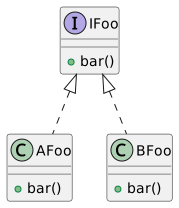
#pragma once

#include <iostream>

class IFoo
{
public:
    virtual ~IFoo() = default;
    virtual int bar() const = 0;
};

class AFoo : public IFoo
{
public:
    int bar() const override
    {
        std::cout << "AFoo::bar()" << std::endl;
        return 42;
    }
};

class BFoo : public IFoo
{
public:
    BFoo(int i) : _i(i) {}
    int bar() const override
    {
        std::cout << "BFoo::bar()" << std::endl;
        return _i;
    }

private:
    int _i;
};
#include "the-foos.h"
#include <string>

int main(int argc, char** argv)
{
    std::string the_argument = argv[1];
    IFoo* foo;

    if (the_argument == "a") {
        foo = new AFoo();
    }
    else if (the_argument == "b") {
        foo = new BFoo(666);
    }

    std::cout << foo->bar() << std::endl;

    delete foo;

    return 0;
}
Statement |
True |
False |
Why |
|---|---|---|---|
A call as shown gives the output as shown $ ./program a
AFoo::bar()
42
|
. |
. |
|
A call as shown gives the output as shown $ ./program b
BFoo::bar()
666
|
. |
. |
|
A call as shown will do nothing because $ ./program c
...?...
|
. |
. |
|
A call as shown will likely crash because $ ./program c
...?...
|
. |
. |